Self-Cleaning Houses: Difference between revisions
No edit summary |
No edit summary |
||
| (9 intermediate revisions by the same user not shown) | |||
| Line 3: | Line 3: | ||
Paste everything below this line as the page content. | Paste everything below this line as the page content. | ||
Text is verbatim from m-a-u-s-e-r.net — kept simple as requested. --> | Text is verbatim from m-a-u-s-e-r.net — kept simple as requested. --> | ||
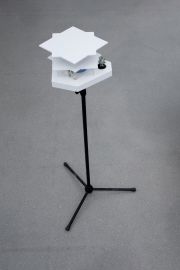
From a series of fragmentary works and speculative research on feminist spatial utopias: The acryl glass object is a model and a mechanism at the same time; it portrays the Self-Cleaning House (Frances Gabe, 1984) and provides a tool to douche itself. The drawings show two completely (inside and outside) tiled houses unfolded, as well as their models. | |||
From a series of fragmentary works and speculative research on feminist spatial utopias: The acryl glass object is a model and a mechanism at the same time; it portrays the Self-Cleaning House (Frances Gabe, 1984) and provides a tool to douche itself. The drawings show two completely (inside and outside) tiled houses unfolded, as well as | |||
The original self-cleaning house that the American inventor also inhabited, implies questions about the role of technology in dismantling patriarchic formations, not so much as it aims at liberating the (female) homeworker, but rather as it gives an idea of women's role in technological development. Contradicting the assumed rational and objective male space that integrates technology with prevailing structures of power, Frances Gabe's house was a space where she felt safe and assured to engineer, learn, and experiment. | The original self-cleaning house that the American inventor also inhabited, implies questions about the role of technology in dismantling patriarchic formations, not so much as it aims at liberating the (female) homeworker, but rather as it gives an idea of women's role in technological development. Contradicting the assumed rational and objective male space that integrates technology with prevailing structures of power, Frances Gabe's house was a space where she felt safe and assured to engineer, learn, and experiment. | ||
The project by Frances Gabe is a patented invention (patent number: 4428085) that consists of sixty-eight appliances to make the house clean and dry itself. By pressing a button, sprinklers in the ceiling of each room are activated, to clean the room with detergent and water followed by hot air drying. The building construction does not only clean the house but also clothes, dishes and even the dog house. The "giant dishwasher", eliminates (mainly) women's reproductive labor and unpaid housework, in a completing of the Frankfurt kitchen concept. | The project by Frances Gabe is a patented invention (patent number: 4428085) that consists of sixty-eight appliances to make the house clean and dry itself. By pressing a button, sprinklers in the ceiling of each room are activated, to clean the room with detergent and water followed by hot air drying. The building construction does not only clean the house but also clothes, dishes and even the dog house. The "giant dishwasher", eliminates (mainly) women's reproductive labor and unpaid housework, in a completing of the Frankfurt kitchen concept. | ||
''Commissioned for 50 Years after 50 Years of the Bauhaus, Württembergischer Kunstverein Stuttgart, 2018, curated by Iris Dressler and Hans Christ'' | |||
Württembergischer Kunstverein Stuttgart | |||
<gallery mode="packed" heights="180"> | <gallery mode="packed" heights="180"> | ||
File:SelfCleaningHouses-Lead.jpg | File:SelfCleaningHouses-Lead.jpg|thumb|500px|''Model and self-cleaning mechanism, WKV Stuttgart, 2018'' | ||
File:SelfCleaningHouses-02.jpg | File:SelfCleaningHouses-02.jpg | ||
</gallery> | |||
<gallery mode="packed" heights="180"> | |||
File:SelfCleaningHouses-04.jpg | File:SelfCleaningHouses-04.jpg | ||
File:SelfCleaningHouses-06.jpg | File:SelfCleaningHouses-06.jpg | ||
</gallery> | |||
<gallery mode="packed" heights="180"> | |||
File:Selfcleaning_houses_23.jpg|thumb|500px|''Models of tiled houses (2018), Barın Han, 2025'' | |||
File:Selfcleaning_houses_24.jpg | |||
File:Selfcleaning_houses_21.jpg | |||
</gallery> | </gallery> | ||
[[Category:Projects]] | [[Category:Projects]] | ||
[[Category:Self-Cleaning Houses]] | [[Category:Self-Cleaning Houses]] | ||
Latest revision as of 09:34, 30 August 2026
From a series of fragmentary works and speculative research on feminist spatial utopias: The acryl glass object is a model and a mechanism at the same time; it portrays the Self-Cleaning House (Frances Gabe, 1984) and provides a tool to douche itself. The drawings show two completely (inside and outside) tiled houses unfolded, as well as their models.
The original self-cleaning house that the American inventor also inhabited, implies questions about the role of technology in dismantling patriarchic formations, not so much as it aims at liberating the (female) homeworker, but rather as it gives an idea of women's role in technological development. Contradicting the assumed rational and objective male space that integrates technology with prevailing structures of power, Frances Gabe's house was a space where she felt safe and assured to engineer, learn, and experiment. The project by Frances Gabe is a patented invention (patent number: 4428085) that consists of sixty-eight appliances to make the house clean and dry itself. By pressing a button, sprinklers in the ceiling of each room are activated, to clean the room with detergent and water followed by hot air drying. The building construction does not only clean the house but also clothes, dishes and even the dog house. The "giant dishwasher", eliminates (mainly) women's reproductive labor and unpaid housework, in a completing of the Frankfurt kitchen concept.
Commissioned for 50 Years after 50 Years of the Bauhaus, Württembergischer Kunstverein Stuttgart, 2018, curated by Iris Dressler and Hans Christ
-
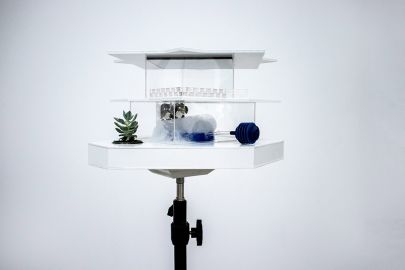 Model and self-cleaning mechanism, WKV Stuttgart, 2018
 -


-
 Models of tiled houses (2018), Barın Han, 2025
 -

-


