Feminist Utopian Spaces
| Type | Speculative research and production, various media |
|---|---|
| Year | 2018 |
| Venues | Württembergischer Kunstverein Stuttgart Kunsthalle Lingen |
| Exhibitions | 50 Years after 50 Years of the Bauhaus (4 May – 23 Sep 2018) Schluss mit reden, spielen wir! (7 Jun – 25 Aug 2019) |
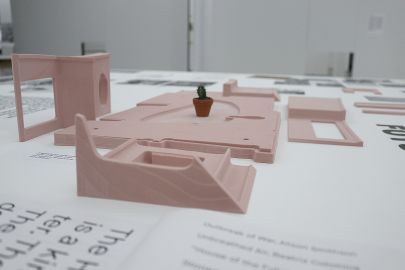
The Feminist Utopian Spaces Lexicon (2018) is a speculative research and production project by Mona Mahall and Asli Serbest exploring currents of thought and practice — from 1918 to 2018 by way of 1968 — that have produced alternative futures through a feminist perspective.
Description
Architectural projections and speculations, utopian ideas and visions are introduced and discussed in a moment of political and social regression. Reacting to the ideological implications and effects of modernism, these works produce concepts for new material, social, political, and aesthetic spaces.
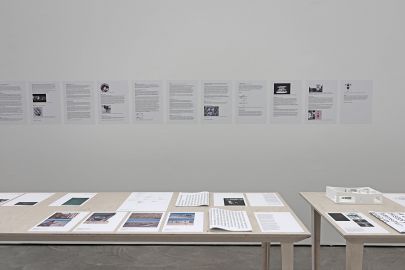
Among others, the lexicon includes Shulamith Firestone, Alice B. Toklas, Maria Telkes, Eleanor Raymond, Marlene Moeschke-Poelzig, Alison Smithson, Alice Constance Austin, Frances Gabe, Varvara Stepanova, and Janelle Monáe. In terms of structure, the lexicon is developed as an open and growing archive that can go from a word to a phrase, from a drawing to a floor plan, from a video to a model, from an argument to an entire text.
If a short text by Walter Benjamin introduces the destructive character (1931) as the modern activity of clearing away, of making room — in need for fresh air and open space — it seems to read back a Bauhaus program. Through complete reduction, thereby deleting the traces of its age and rooting out its own condition, the destructive character obtains the potential for a new beginning. The zero point, a tabula rasa of form, allowed a start anew, to produce neutral, ultimately cleared spaces that could even impede leaving traces, as Benjamin noted in reference to glass architecture.
Once combined with a structural grid, glass architecture could actually deliver fresh air and open space — at any scale, be it furniture, a pavilion, school, skyscraper, or a city. The generic and radically rational nature implied in the grid system with glass surface is explored by Ludwig Hilberseimer's project for a Hochhausstadt (1924), organizing a city of three million inhabitants upon a calculation of one square window per person. In 1933, when the Gestapo accused the German architect and planner of being "problematically left-wing," Hilberseimer emigrated to the U.S., where he began teaching alongside Mies van der Rohe at the Illinois Institute of Technology. Simultaneously, Walter Gropius headed the Harvard Graduate School of Design in Cambridge. Both became heroic figures, made in the U.S., who allowed for the consolidation (commodification) of Bauhaus modernism and its reimport to Europe.
From the U.S., Bauhaus returned not just as a style — a new tradition allowing identification with a free and democratic, capitalist West against a Communist East — it also signified a spatial matrix of recycled military technologies through which expanding capitalism could advance globally after the Second World War, helping shape a techno-political postwar space paradoxically exposed to the threat of complete destruction through a new global war.
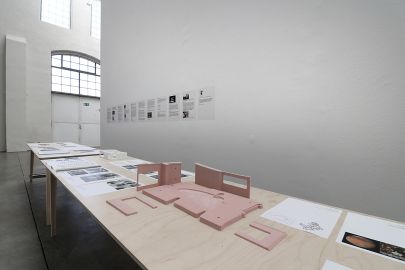
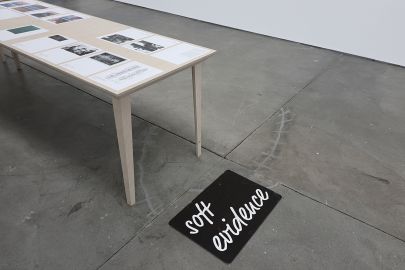
With some impact, the radical architecture and neo-avantgarde movements of the 1960s and 1970s, as well as so-called postmodern tendencies, confronted classical modernism. Yet architecture and the production of space as a mode of social and political engagement with a feminist agenda has remained almost invisible. The installation therefore aims at making room for a fragmentary collection and production of videos, plans, images, and models of feminist visions — possible other ways of imagining how to live together.
The full text of the lexicon is available at Feminist Spatial Utopias Lexicon.
Exhibition history
- 50 Years after 50 Years of the Bauhaus, Württembergischer Kunstverein Stuttgart — 4 May – 23 September 2018
- Schluss mit reden, spielen wir!, Kunsthalle Lingen — 7 June – 25 August 2019
Gallery
-
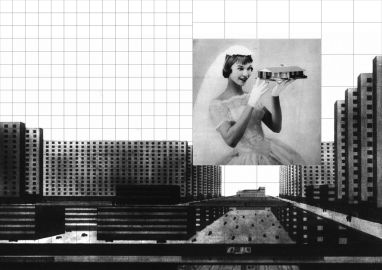 Feminist Utopian Spaces Lexicon
 -
-
-

-
-